
Some of the theoretical developments in the computation of
form factors have resulted in significant deviations from earlier
work, which can be tested by suitable experiments. Here the atomic
scattering factor is given for Uranium at medium X-ray energies (keV). Click
the figure for the corresponding attenuation coefficients.
X-ray optics is concerned with the interaction of photons with matter. High energy (X-ray) photons are of direct interest, because this often reflects the dominant atomic structure and atomic physics. However VUV photons and gamma-rays are also subjects of investigation.
Quantum Electrodynamics is one of the two best-tested theories in physics and science, and lies at the heart of atomic physics. Yet certain problems in its formulation lead people like Roger Penrose to assume that there are fundamental flaws in the theory which may be revealed by an appropriate experiment. The type of experiment pursued here may reveal such an inadequacy, by being more sensitive to important terms and interactions than other available tests. QED is the primary explanation of the interaction of light and charge, and is fundamental to much of the physics which we assume and rely on in the world today.
The beauty of (X-ray) optics and atomic physics is that they are among the most accessible to simultaneous theoretical and experimental investigations. This means that your project in this field could be predominantly theoretical or experimental, without losing sight of the direct link to the other. Usually a Masters or Doctorate would involve linking those two threads together in a coherent whole.

Our group at the University of Melbourne is exploring the interaction of light with matter, on an experimental and theoretical basis. Particular interest relates to Phase Retrieval and the development of X-ray phase imaging; X-ray focussing using Capillary Optics; Absolute Intensities in X-ray Diffraction; Precision tests of QED; Understanding atomic form factors and near-edge structure; X-ray interactions with photographic emulsions; Dynamical diffraction; The Lobster-eye telescope; and Mammography.
 Multi-channel X-ray Optics and The Lobster-eye Satellite
 Precision tests of QED
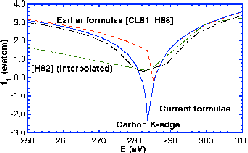 Theory and computation of Atomic Form Factors
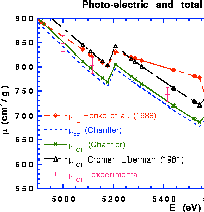 Experimental measurement of attenuation and scattering in
matter
Experimental measurement of attenuation and scattering in
matter
 Interaction of X-rays with photographic emulsions
 Improved densitometry/characterisation of X-ray emulsions
 Novel High-energy Sources for QED tests
 Synchrotron Beamline Developments / Studies
 Single Capillary Optics and X-ray focussing
For references and publications, see the home pages (e.g. Chantler).
We have the first FeinFocus 160 keV, 5 micron spot size X-ray source in Australia. We have a number of useful detectors including state-of-the-art spectrometry and backgammon detection systems developed here and with the assistance of NIST, USA. We are continuing to build up this x-ray optics lab, based on an ARC Infrastructure Support Grant, a large ARC grant, and some smaller grants. We are building / installing:

Dr Chris. Chantler
Optics Group
School of Physics
University of Melbourne
Parkville
Victoria, 3052
AUSTRALIA

Phone: +61 (0)3 9344 5437 (Chantler)
       +61 (0)3 9344 0015 (X-ray Laboratory)
       +61 (0)3 9344 8171 (Optics Computer Room)
Fax:   +61 (0)3 9347 4783
URL:   http://optics.ph.unimelb.edu.au/home.html
email: chantler@ph.unimelb.edu.au
There have been accesses to this page since October 20, 1995.
 Optics Group